Joint work with Alonso Alfaro-Ureña. Forthcoming at the American Economic Journal: Microeconomics.
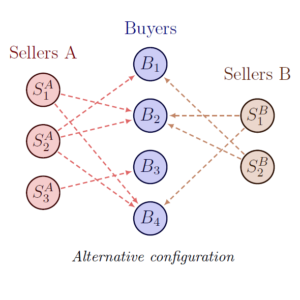 Abstract. We build a model of production network formation that enables econometric estimation of the determinants of supplier choice, like trade costs or matching frictions. The model informs an estimator obtained from a transformation of the multinomial logit likelihood function that conditions on two network statistics: the out-degree of sellers (a sufficient statistic for the seller marginal costs) and the in-degree of buyers (which is determined by decisions of buyers, like “make-or-buy”). In an empirical application, this estimator shows that a prominent Costa Rican highway fostered firm-to-firm connections between core and peripheral regions, and within the core regions themselves.