Joint work with Alonso Alfaro-Ureña. Forthcoming at the American Economic Journal: Microeconomics.
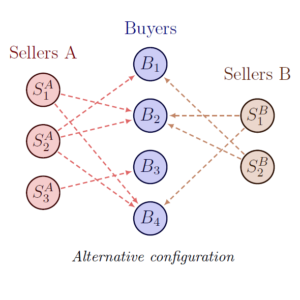
Abstract. We build a model of production network formation that enables econometric estimation of the determinants of supplier choice, like trade costs or matching frictions. The model informs an estimator obtained from a transformation of the multinomial logit likelihood function that conditions on two network statistics: the out-degree of sellers (a sufficient statistic for the seller marginal costs) and the in-degree of buyers (which is determined by decisions of buyers, like “make-or-buy”). In an empirical application, this estimator shows that a prominent Costa Rican highway fostered firm-to-firm connections between core and peripheral regions, and within the core regions themselves.
Joint work with Helena Schweiger and Alexander Stepanov. Published in: the American Economic Journal: Economic Policy, 14(3), August 2022 (pp. 322-351). VoxEU summary here.

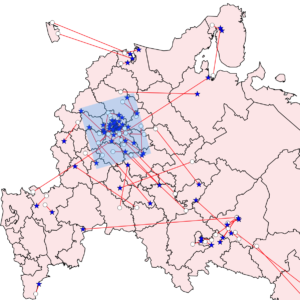
Abstract. We study the long-run effects of historical place-based policies targeting R&D: the creation of Science Cities in former Soviet Russia. The establishment of Science Cities and the criteria for selecting their location were largely guided by military and strategic considerations. We compare current demographic and economic characteristics of Science Cities with those of appropriately matched localities that were similar to them at the time of their establishment, and had similar pre-trends. We find that in present-day Russia, despite the massive cuts in government support to R&D that followed the dissolution of the USSR, Science Cities still host more highly skilled workers and more developed R&D and ICT sectors; they are the origin of more international patents; and they generally appear to be more productive and economically developed. We also rule out alternative explanations related to the differential use of public resources, and we find limited evidence of reversion to the mean. By estimating a spatial equilibrium model in our matched sample, we interpret these findings as the result of the interaction between persistence and agglomeration forces.

Published in: the Review of Economic Studies, 84(7), July 2020 (pp. 1989-2018)

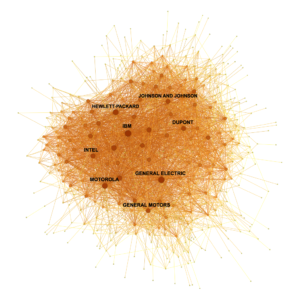
Abstract. In this article, I directly test the hypothesis that interactions between inventors of different firms drive knowledge spillovers. I construct a network of publicly traded companies in which each link is a function of the relative proportion of two firms’ inventors who have former patent collaborators in both organizations. I use this measure to weigh the impact of R&D performed by each firm on the productivity and innovation outcomes of its network linkages. An empirical concern is that the resulting estimates may reflect unobserved, simultaneous determinants of firm performance, network connections, and external R&D. I address this problem with an innovative IV strategy, motivated by a game-theoretic model of firm interaction. I instrument the R&D of one firm’s connections with that of other firms that are sufficiently distant in network space. With the resulting spillover estimates, I calculate that among firms connected to the network the marginal social return of R&D amounts to approximately 112% of the marginal private return.